
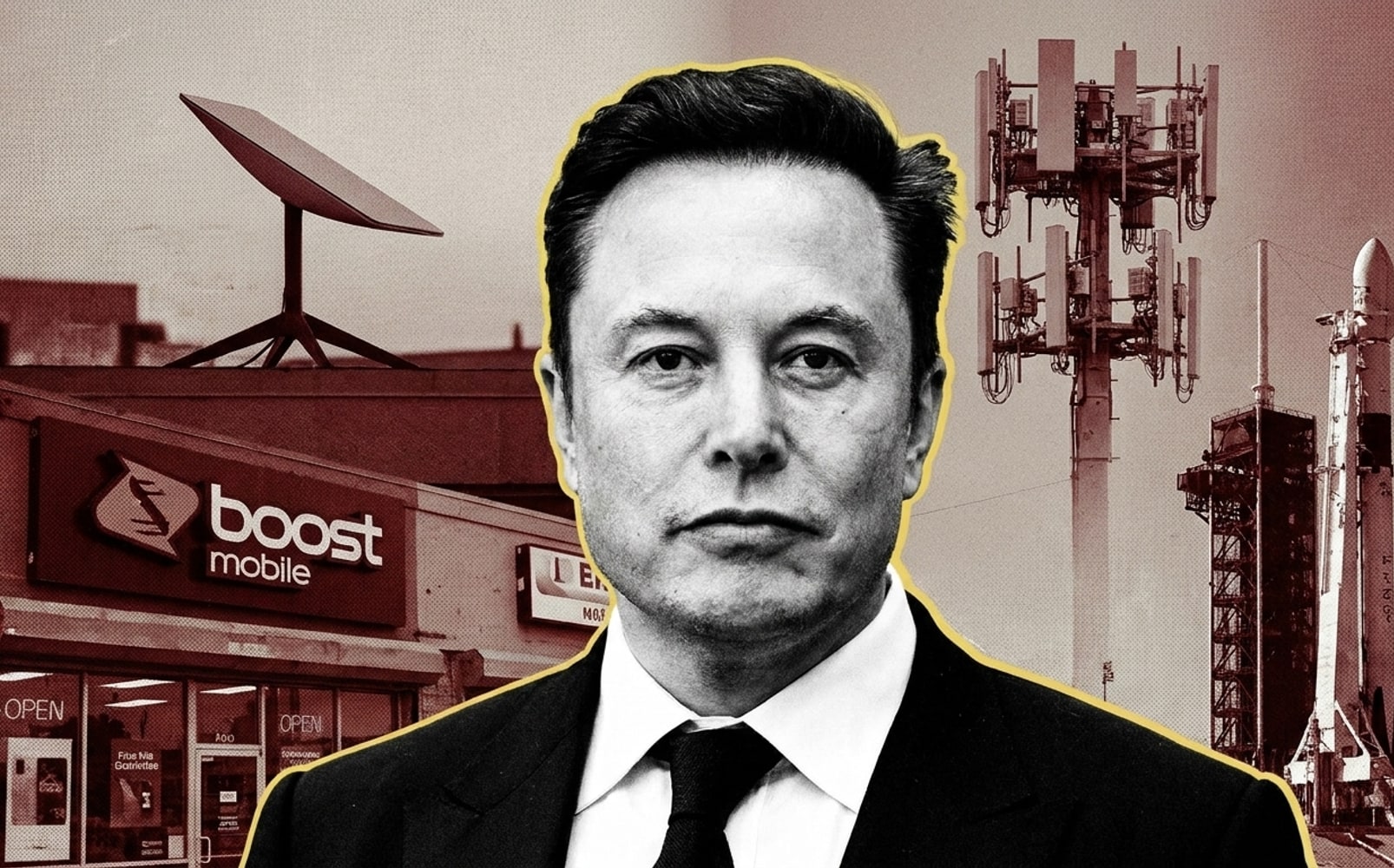

SpaceX is in talks to buy Boost Mobile from EchoStar, or alternatively to run a service over Boost's network, The Washington Post reported on November 2nd, 2026. The Post framed the move as a back door into a United States wireless market that research firm MoffettNathanson sizes at $235 billion.
The talks follow rejections. The Post reported that Musk approached Verizon, AT&T and T-Mobile about renting space on their networks for a SpaceX mobile service and was turned down by all three. EchoStar (NASDAQ: SATS) shares rose about 4% in pre-market trading on Monday, November 2nd, 2026 following the report, per Yahoo Finance.
What happened
Citing people familiar with the negotiations, the Post reported that Musk met EchoStar chairman and chief executive Charlie Ergen last month, in October 2026, about a potential transaction. Yahoo Finance described the sourcing as two people familiar with the talks.
Reuters reported that SpaceX intends to build a mobile network called Starlink Mobile blending satellite and terrestrial technology, and that a Boost deal would hand it an existing customer base and distribution, according to Quartz. EchoStar's wireless subscriber base stood at 7.38 million as of the end of the second quarter of 2026, with Boost Mobile and Gen Mobile accounting for most of them.
Why it matters to the stock
SpaceX is itself publicly traded. It listed on Nasdaq under the ticker SPCX on June 12th, 2026, per CNBC's IPO coverage. You can see the price history on /companies/SPCX.
The Boost report lands weeks after a larger move. On October 8th, 2026, SpaceX agreed to acquire a nationwide low-band spectrum portfolio from Grain Management for $8 billion, per The Wall Street Journal as relayed by Axios on October 9th, 2026. Axios said AT&T, Verizon and T-Mobile shed roughly $36 billion in combined market value on that news, while SpaceX rose about 3%, or $67 billion, in pre-market trading. Musk wrote on X that the purchase was the last critical piece of the spectrum puzzle needed for SpaceX to provide complete phone coverage in America.
What the record shows
There is no deal on the record. Yahoo Finance reported that neither company has provided financial projections for a Boost Mobile transaction or for a SpaceX-branded wireless service, and no SEC filing or company confirmation of a Boost agreement had been made public as of November 2nd, 2026.
What is on the record is a prior transaction between the two. In September 2025, SpaceX agreed to buy EchoStar's AWS-4 and H-block spectrum licenses for about $17 billion, split between up to $8.5 billion in cash and up to $8.5 billion in SpaceX stock, according to EchoStar at the time.
Prediction market pricing is contested. Benzinga reported on November 2nd, 2026 that the chance SpaceX launches a United States mobile phone plan by June 2027 jumped to 22% from 13% the prior day, with the end-of-2027 contract rising to 28% from 26%. An earlier Benzinga and Yahoo Finance piece, roughly 20 days before, put the same contracts at 26% by June 2027 and 43% by end-2027. Beinsure reported the end-2027 probability recently fell to about 27% from 37% a week earlier, on a contract with more than $16,000 in traded volume. Beinsure also noted the contract settles Yes even if SpaceX launches a branded plan running on another carrier's network.
What to watch
The structural catch is Boost's own plumbing. Boost leases network capacity from AT&T and T-Mobile as an MVNO, and those agreements may not transfer to a buyer without carrier consent, meaning a SpaceX-run service could need sign-off from two companies that already said no. Broadband Breakfast reported on November 2nd, 2026 that analysts were skeptical the agreements are transferable.
The cost and the clock are the other two variables. Bloomberg reported last month that SpaceX is in talks for at least 80,000 cell sites, with TD Cowen putting the build at more than $80 billion, per TIKR. Beinsure cited estimates that SpaceX could need another $120 to $130 billion, including roughly $90 billion more in spectrum and about $40 billion for the cell sites. Verizon publicly estimated four to six years to stand up a competing network; Musk replied on X that it will take 2 or 3 years.
On SpaceX's third-quarter 2026 earnings call in October, Musk said the company would build out its terrestrial network and that satellite launches and spectrum purchases would pave the way for Starlink Mobile to become a major mobile carrier in the United States, per Data Center Dynamics. One note on identifiers: a Benzinga write-up referred to EchoStar under the ticker ECHO, which conflicts with the SATS ticker used in Yahoo Finance and Reuters-sourced coverage.
Reporting from The Washington Post, Yahoo Finance, Quartz, Light Reading, Broadband Breakfast, Axios, Benzinga, TIKR, Data Center Dynamics, Beinsure and CNBC, as of November 2nd, 2026.
Informational only, not investment advice.